


 Photo Agency
A spending plan that would terminate the record-setting federal closure in US history is reaching the House of Representatives for a crucial vote on midweek.
On the sixth week of the political impasse, representatives are reassembling in Washington to decide whether to approve a Senate package that would support public services for the next eight weeks.
GOP leaders expressed confidence the funding measure would pass through the lower chamber, notwithstanding their narrow majority. But leading opposition members vowed to oppose it.
"We're opening up our United States," he announced on the previous day at a military commemoration in the DC area. "Should have never been closed."
Consequences of the Shutdown
The funding gap, which began on October 1st, has caused a public sector staff missing wages, suspended SNAP benefits for economically vulnerable citizens, and slowed flights for passengers ahead of the November celebration.
With over a thousand trips cancelled on Tuesday as furloughed aviation staff take sick leave because of the budget impasse, lawmakers are finding other ways to travel to DC.
- Congressman Rick Crawford of Arkansas announced online that he was sharing transportation with a fellow Republican, Representative Kelly of the Magnolia State, to the nation's capital.
- Congressman Derrick Van Orden announced he was riding a motorcycle from his home state of the Midwest state.
"It will be a little chilly," he posted on X of the long travel. "However, I shall perform my responsibilities."
Legislative Process
The House Rules Committee advanced the bill in a political party ballot by 8-4 in the early hours of the crucial date, concluding a marathon deliberation.
Majority party representatives rejected Democratic amendments attempting to prolong expiring health insurance subsidies - their main demand during the impasse.
The chamber is expected to reconvene at the afternoon session (21:00 GMT) to have a brief deliberation period on the bill before a ballot.
Opposing View
Opposition chief the minority leader of the Empire State vowed to fight the legislation.
"We're strongly opposed as Democratic representatives to this careless majority action to persist in increasing the expensive lifestyle on working families," he stated to the media outlet.
Jeffries has voiced disappointment with the upper chamber minority who supported Republicans on the previous evening to endorse the spending plan.
Key Issues
A primary requirement of the opposition during the funding gap has been that the majority add to the spending bill a provision to extend fiscal incentives that make medical coverage less expensive for a significant population.
But the majority party maintained solidarity and declined to compromise, accepting solely allow a ballot next month on the insurance support, a proposal they had made previously.
And there is no guarantee that provision will get through the Senate, while the Speaker has not yet promised a vote on the tax credits in the House.
Legislative Mathematics
The House leader has maintained congressional recess for nearly two months to pile pressure on Senate Democrats to reach a funding agreement.
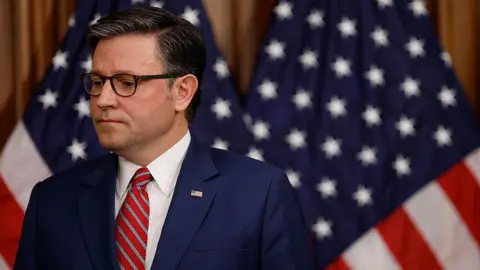
Prior to the crucial ballot he will swear in the new Arizona representative the Democratic candidate, a member of the opposition who won a special election in the previous month.
After she completes the congressional commitment, the majority party margin in the House will be reduced to five votes – a close division.
That indicates Johnson can only afford to lose a couple of majority votes on every political decision.
Fiscal Concerns
The spending plan places the national administration on course to keep adding about $1.8 trillion (British equivalent) a annually to its massive existing in government obligations.
But Chip Roy of his home state stated he was "unaware of any opposition of importance" to the proposal from spending watchdogs in his conservative group.
Possible GOP dissenters the libertarian-leaning lawmaker of the Bluegrass State or the Indiana congresswoman of her district have remained tight-lipped so far on how they plan to vote.
But even if they do break ranks, the presiding officer could still get the bill over the line with the assistance from pragmatic minority representatives, such as the Maine representative of the Pine Tree State or Henry Cuellar of his constituency.
Political Fallout
Neither party appears to have emerged without damage from this political standoff.
Opinion polls suggest the public thinks the majority party shoulder slightly more of the responsibility, while minority members were bitterly split by the brinkmanship.
And when the closure concludes, funding legislators have only 60 days to avoid the following crisis.
Government funding would next be due to expire on the end of next month.



